Under the LCD two local organizations benefited from technical assistance to implement data processing platforms for monitoring: Organizations A and B.
Organization A advocates for better quality in primary education in the North of Mozambique. It helps school management committees to improve the school management and the quality of primary education. Organization B mobilizes religious communities, in particular, and society in general, to develop activities for the eradication of malaria in Mozambique.
This story (problem, intervention and results) is on the development and implementation of data processing platforms to help these two Organizations monitor their interventions.
Organization A's monitoring data was not structurally designed and stored as a data base. Data was stored using a “general table”. Cells were merged, blank cells appeared in the middle of tables, etc. Thus, information could not be easily and efficiently produced in the form of charts and/or tables.
Instead of recording the data for each implementation period, the M&E staff would calculate cumulative data in a separate hand calculator and replace the last period accumulated data with new data.
Thus, it was not possible to conduct times series analyses. Organization B records its activities in three different data bases. Data is entered at provincial level.
Quarterly the 5 provinces send three files each to headquarters. In total, headquarters receive 15 database files quarterly (60 files a year). The manual data consolidation and processing of 15 files is very time consuming and inefficient.
No dashboard, chart or tables were developed to present readable information. Thus, data was recorded, but not adequately analyzed. In Organization B part of the data was not even being processed and analyzed.
There was no data to inform project indicators on Organization A. Thus, level of achievement was not analyzed.
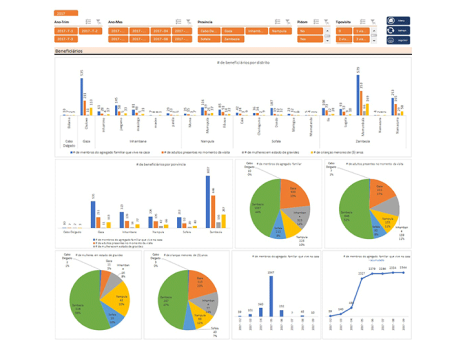
Through the LCD initiative, EUROSIS’ technical assistance team and Organization A’s staff restructured the data base and developed a simple and effective dashboard.
The technical assistance team worked with these Organizations to: a) identify the main constraints of the data bases in place;
b) define requirements for improved monitoring data bases; c) design and develop data bases according to their requirements; d) design and develop dashboards; e) provide remote support to ensure sustainable use of the new platforms.
The data recorded at Organization A data base is now properly converted into information that can be used to better decision making regarding the improvement of quality in primary schools in five districts in the North of Mozambique.
At Organization B, the 15 databases files produced quarterly are automatically consolidated and, charts and tables produced for a better data analysis and decision taking.